

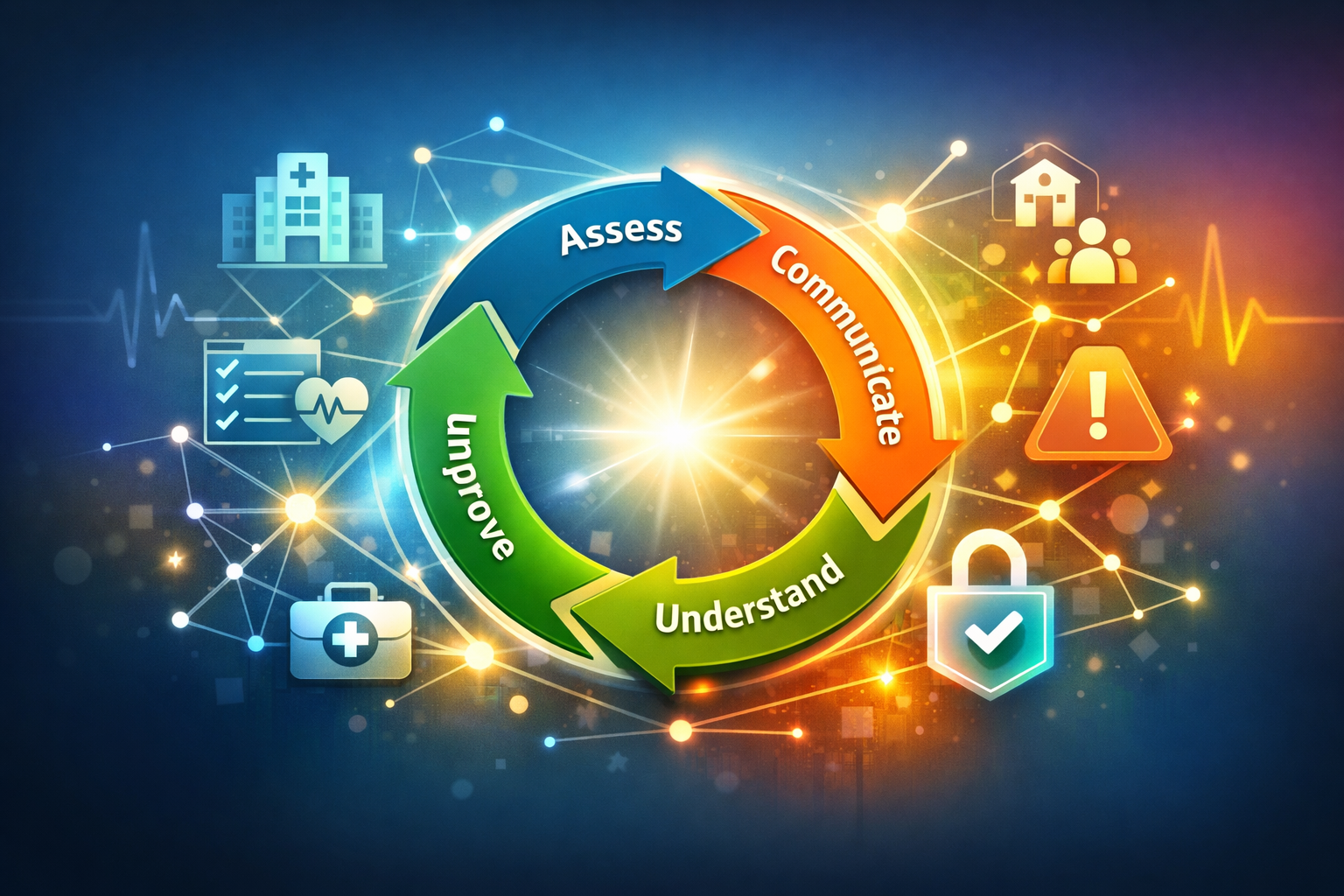
Why Closing the Loop Is a Safety Imperative
In our first conversation here, we explored a quiet truth: when communication breaks down, care breaks down too. Often subtly. Often invisibly.
But there is another layer we don’t talk about enough.
Breakdowns in understanding are rarely random.
They follow patterns. And when systems fail to identify why they happen, well-intentioned care can unintentionally cause harm.
When Barriers Are Named—but Root Causes Aren’t
Healthcare and behavioral health systems are increasingly aware of barriers:
Language differences, health literacy, transportation, housing instability, food insecurity, and time constraints.
These are real. Social determinants of health matter.
But identifying barriers without understanding how they interact with communication can be dangerous.
If we don’t ask:
- Where meaning broke down
- What assumptions were made
- What pressures shaped the interaction
- What happened after the encounter
…we risk treating symptoms instead of causes.
And when root causes go unexamined, systems repeat the same failures—sometimes with higher stakes.
Effective Communication Is a Safety Function
Organizations such as The Joint Commission and the Institute for Healthcare Improvement have consistently identified communication failures as contributing factors to sentinel events, delayed care, and preventable harm.
Not because information wasn’t delivered—but because understanding wasn’t verified, reinforced, or supported over time.
Effective communication isn’t an interpersonal preference.
It’s a core safety mechanism.
When it fails:
- Follow-up instructions aren’t acted on
- Warning signs are missed
- Referrals stall
- Trust erodes
- Risk accumulates quietly
By the time harm surfaces, the original breakdown is often far upstream—and long forgotten.
The Danger of Open Loops
In improvement science, open loops create risk.
A message sent but not confirmed.
A referral placed but not completed.
A concern noted but not explored.
Communication failures behave the same way.
If systems don’t close the loop on understanding, they operate on assumptions:
- “They heard us.”
- “They understood.”
- “They’ll follow through.”
But assumptions are not safeguards.
Closing the loop means asking:
- What did this mean to the patient or family?
- What barriers surfaced after the visit?
- What changed once they returned to real life?
- Who noticed confusion—but had nowhere to escalate it?
Without these feedback loops, safety becomes reactive instead of designed.
Root Cause Analysis Requires Listening—Not Just Data
Root cause analysis is often treated as a retrospective tool, triggered after something goes wrong.
But communication breakdowns offer early warning signals—if systems are designed to hear them.
Staff, interpreters, care coordinators, and community partners often notice patterns:
- Recurrent confusion
- Repeated no-shows
- Emotional disengagement
- Families asking the same questions in different ways
These aren’t individual failures. They are system messages.
As emphasized in improvement forums like the Conference on Health Impact Assessment and the IHI learning communities, meaningful improvement depends on understanding variation, context, and lived experience, not just outcomes.
When those signals are ignored, risk compounds.
Social Determinants Don’t Replace System Responsibility
Social determinants shape people’s capacity to engage with care—but they do not absolve systems from responsibility.
When systems fail to adapt communication to context, they quietly transfer risk onto patients and families:
- To remember
- To interpret
- To navigate
- To compensate for complexity under stress
That is not resilience.
That is system fragility disguised as patient burden.
Designing for Safety Means Designing for Understanding
At Lunacor Health Collaborative, we approach effective communication as infrastructure—not an add-on.
That means:
- Treating understanding as something to be supported across time, not assumed in a moment
- Using breakdowns as data, not inconveniences
- Closing loops before harm occurs
- Designing systems that learn from what doesn’t land
This isn’t about blaming people.
It’s about building systems that can see, hear, and respond to early signals—before risk turns into harm.
A Question Worth Asking
If safety depends on closed loops,
and understanding is central to safety…
Where are our systems still operating on assumptions instead of evidence?
That’s where the work begins.